Companies that trust BrownPipe










Offensive Security
In-depth penetration testing for organizations that cannot afford operational, regulatory or reputational risks.
Companies that trust BrownPipe
For your business
Meet audit requirements, Data Protection Compliance or contractual obligations from clients
Validate security before go-live of applications or critical changes
Support executive decision-making on real risks
Confirm whether the environment exposure is greater than the internal team perceives
Use the security budget strategically with measurable results
Leverage security as a competitive advantage, not just a cost
Categories

Web applications and critical systems
Assesses business-critical web applications, including authentication, authorization and business logic. We identify vulnerabilities that could expose sensitive data, allow unauthorized access or compromise operational integrity.

REST, GraphQL APIs and integrations
Evaluates the security of REST and GraphQL APIs, including authentication, authorization, data validation and attack protection. We test critical integrations that connect systems and expose sensitive data.

Networks, servers and exposed services
Identifies risks in networks, servers and exposed services (internal or external), including Active Directory, network services and firewall configurations. We test perimeter security and the ability for lateral movement within the environment.

iOS and Android applications
Assesses iOS and Android applications, including local storage, backend communication, authentication and reverse engineering protection. We verify whether sensitive data is protected and if the application resists manipulation attempts.
Methodology
Our methodology combines automated tools with specialized manual analysis. Each test is planned considering the business context, sector-relevant threats and the organization's specific objectives.
We document every finding with clear evidence and practical remediation recommendations, maintaining constant communication with your team throughout the entire process.
Talk to a specialistKickoff meeting, receipt of credentials and documentation, scope and endpoint confirmation.
Attack surface mapping, technology identification and environment entry points.
Manual and automated tests, with immediate communication of critical vulnerabilities found.
Delivery of executive and technical report, followed by a results presentation meeting.
Validation of fixes implemented by the team, with vulnerability status update.
Standards
OWASP Web Security Testing Guide
OWASP Top 10
OWASP ASVS
CWE Top 25
OWASP Mobile Application Security
PCI DSS v4.0
NIST SP 800-115
Approaches
Minimal information about the target
Simulates the perspective of an external attacker with no prior knowledge of the environment. The pentester receives only public information, such as URLs or IPs, and must discover vulnerabilities without access to documentation, credentials or source code. Ideal for assessing how exposed the organization is to external threats.
Credentials and partial documentation
Balances realism with efficiency. The pentester receives standard user credentials and partial environment documentation. Allows focus on critical areas without spending time on basic reconnaissance. Recommended when there are time or budget constraints but reasonable coverage is desired.
Full access to the environment
Maximum coverage and depth. The pentester has access to source code, architecture, administrative credentials and complete documentation. Enables identification of vulnerabilities that would be difficult to find externally, including business logic flaws and insecure configurations. Offers the best return on investment in terms of vulnerabilities identified.
Deliverables
Each flaw documented with exploitation evidence
CVSS classification to guide remediation efforts
Management-level view with risks and strategic recommendations
Details for the IT team to implement fixes
Discussion of findings with technical team and management
Validation of implemented fixes at no additional cost
Platform
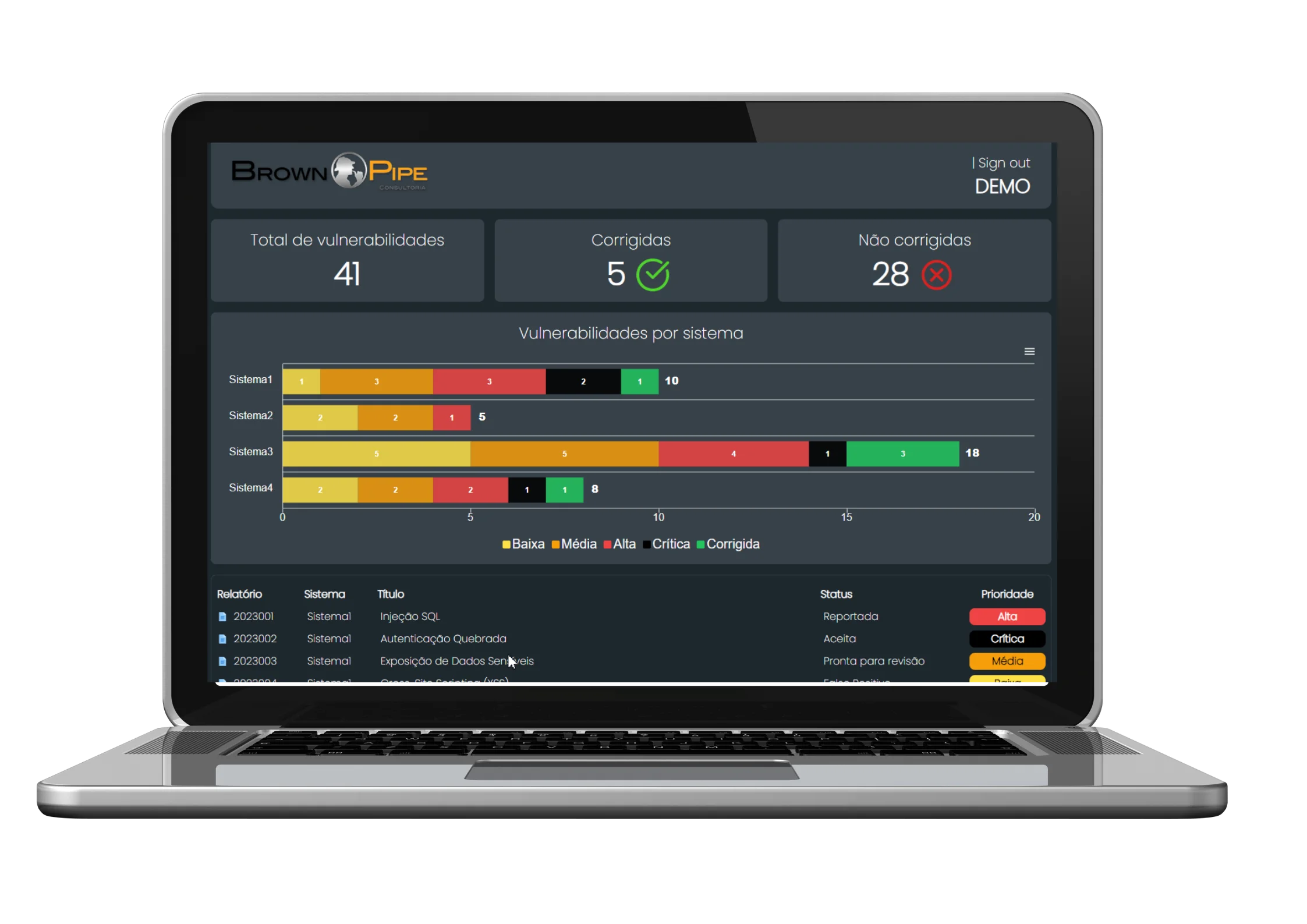
We use Moriarty, our vulnerability management platform, to track the criticality, status and history of every finding.
Your team gets access to the dashboard to monitor remediation progress, prioritize actions and maintain a historical record of all tests performed.
Differentials
Accumulated expertise in information security
Finance, healthcare, retail and technology
Tests adjusted to the business context and risk profile
Consultants with extensive training and over 20 years of experience in information security
OWASP, NIST and PCI DSS as the methodological foundation
Access to the testing team to discuss vulnerabilities, plan fixes and evaluate risk acceptance
Video
Common questions
A Pentest, or Penetration Test, is a proactive, authorized process to evaluate a system's security. It simulates attacks by a malicious actor, using the same tools and techniques, to identify vulnerabilities and weaknesses before real attackers can exploit them.
A vulnerability scan is an automated process that identifies known flaws. A Pentest goes further: our specialists manually exploit vulnerabilities, test business logic and simulate real attack scenarios that automated tools cannot detect.
Yes. Data protection regulations require organizations to implement adequate security measures. A Pentest demonstrates due diligence in protecting personal data and can serve as evidence of compliance in audits and regulatory processes.
The duration depends on the scope. Tests focused on a single web application may take 5 to 10 days. Larger projects involving multiple systems or full infrastructure may require 15 to 30 days. The report is delivered within 20 business days after test completion.
We plan every test to minimize risks. We always align scope, schedules and limitations beforehand. More invasive tests can be performed in staging environments. In production, we adopt controlled approaches and maintain constant communication with your team.
Yes. We recommend annual tests at a minimum, or after significant changes to the environment (new applications, system integrations, cloud migration). For critical environments, we offer a Continuous Pentest option.
Critical vulnerabilities are communicated to your team immediately, even before the final report. This allows emergency fixes to begin while testing continues. After remediation, we perform a retest at no additional cost.
It is better to identify and fix weaknesses before an attacker finds them. The cost of a single incident often outweighs the investment in prevention.
Get in touch